
 Back to the news page
First muscle signal
Our third prototype, marked a major step forward. It was the first time we successfully linked muscle signals to movement.
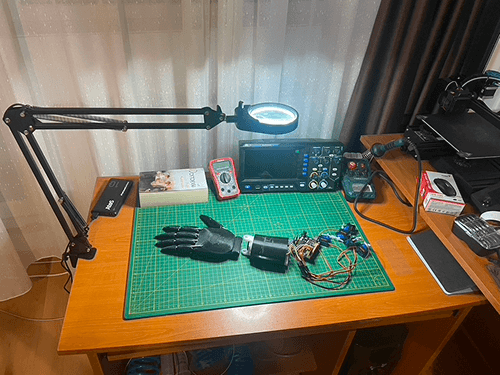
Built from scratch with a custom design, it featured a single actuated finger mounted on a demonstration stand. It responded to real electric signal input, translating muscle activity into motion. While limited in scope, this was our first proof of concept for signal-driven control.
Through this prototype, we began studying the fundamentals of myoelectric communication: signal clarity, responsiveness, and the reliability of muscle input under different conditions. It helped us understand how to build more accurate and responsive control systems, laying the groundwork for future development.
Although it was never intended to be worn, this prototype played a key role in shaping our approach to control fidelity and user interaction. It was an essential step in moving from theory to applied function, and it brought us closer to the goal of intuitive, human-centered prosthetics.